
As AI models continue to grow in size and complexity, organizations need infrastructure that can deliver both exceptional training performance and seamless scalability. In the latest MLPerf Training v6.1 benchmark results, QCT showcased the capabilities of their QuantaGrid D75U-1U platform, demonstrating strong performance across multiple AI workloads while scaling deployments on the NVIDIA GB300 NVL72 rack-scale architecture.
MLPerf Training has become the industry’s most widely recognized benchmark for evaluating machine learning training systems. The benchmark measures how quickly a system can train a variety of AI models to predefined quality targets, providing customers with an objective view of real-world AI training performance.
For the MLPerf Training v6.1 submission, QCT leveraged its QuantaGrid D75U-1U, configured for the NVIDIA GB300 NVL72, and evaluated performance across multiple GPU scales, including:
- 8 GPUs
- 16 GPUs
- 64 GPUs
- 72 GPUs
This broad range of testing highlights the platform’s ability to efficiently scale from simple AI projects to large-scale foundation model training environments.
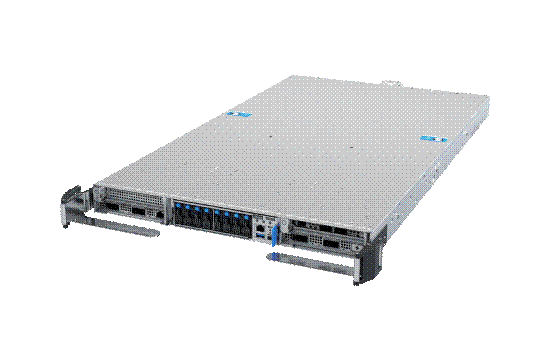
Fig. 1. QCT QuantaGrid D75U-1U
The NVIDIA GB300 NVL72 with the QuantaGrid D75U-1U built by QCT brings enhanced compute and memory capabilities to power next-generation AI. Composed of 18 QuantaGrid D75U-1U compute trays accelerated by NVIDIA Blackwell Ultra GPUs (4 GPUs per node) and 9 NVIDIA NVLink Switch trays, it features up to 72 interconnected NVIDIA Blackwell Ultra GPUs acting as one gigantic GPU, delivering exceptional 1,440 PFLOPS performance for FP4 and 720 PFLOPS for FP8/FP6. Enhanced with 130 TB/s of NVLink scale-up bandwidth, 20 TB of HBM3e memory per rack and 800 Gb/s scale-out connectivity per GPU provided by NVIDIA ConnectX-8 SuperNIC, it delivers unmatched performance for large-scale AI training, generative AI, and high-throughput inference workloads.
For MLPerf Training v6.1, QCT’s submissions included the following four representative MLPerf benchmarks:
- Llama 3.1 8B – The Llama 3.1 8B benchmark measures the training efficiency of a modern generative AI model, highlighting the platform’s capability to support conversational AI, content generation, and enterprise copilots.
- FLUX.1 – The FLUX.1 benchmark assesses text-to-image synthesis performance, demonstrating the platform’s readiness to handle next-generation creative AI and visual generation workloads.
- Llama2 70B LoRa – The Llama 2 70B LoRA (Low-Rank Adaptation) benchmark evaluates parameter-efficient training techniques that reduce compute requirements while accelerating AI customization. It highlights a highly cost-effective method for fine-tuning one of the largest open-weights models available in the Llama 2 family.
- DLRMv4 – The DLRMv4 (Deep Learning Recommendation Model) benchmark represents real-world recommendation model training, helping evaluate performance for e-commerce, digital advertising, and personalized content delivery applications.
These benchmarks span natural language processing, image generation, large language model (LLM) fine-tuning, and recommendation, demonstrating versatility across today’s most demanding AI applications.
The MLPerf Training v6.1 results demonstrate QCT’s continued commitment to delivering infrastructure optimized for the most demanding AI workloads. By combining the scalable design of the QuantaGrid D75U-1U with the performance of NVIDIA GB300 NVL72, QCT provides organizations with a proven platform for training the next generation of AI models. As AI adoption accelerates across industries, customers require infrastructure that scales efficiently, delivers predictable performance, and supports a broad spectrum of workloads. The QuantaGrid D75U-1U is designed to meet those requirements, empowering organizations to move from experimentation to production AI with confidence. To view the MLPerf Training v6.1 results visit https://mlcommons.org/benchmarks/training/.